Primero trataré de explicar el entorno de esta corriente de arte, citando tres factores. El primero es la revolución industrial, la revolución industrial trajo con las manufactureras cambios estructurales profundos en la sociedad: movimiento en las ciudades, trabajo desconectado de la familia y de la casa, una cierta automaticidad y lo que podríamos llamar el principio de una cultura de consumo y de placer, se debe comprar el placer.
El segundo factor es la fotografía, el primero en hacer fotografías es el francés Daguerre en 1838; por eso la primera fotografia se llamo el daguerrotipo, es decir, es la capacidad de tener una realidad instantánea. Inmediatamente se pone la realidad sobre papel; no hay que esperar a que alguien la pinte y obviamente esta más al alcance de todos.
El tercer factor, es un factor del cual pocos hablan pero que es igual de importante, es la inspiración japonesa; lo que se llamó en francés la corriente del Japonisme, el japonismo. Cuando el arte japonés llega a Europa con la apertura del imperio luego de más de cuatrocientos años de haber estado aislado del resto del mundo, los artistas se dan cuenta que el arte japonés es extremadamente expresivo, hay movimiento y quietud, paisajes vibrantes, hay viento y lluvia, hay seres humanos activos, incluso expresiones de silencio y de ruido; las pinturas están vivas.
Estos tres factores que mencioné: la revolución industrial, la fotografía y la inspiración japonesa implicó que muchos empezaran a pensar. La idea de salir de las convenciones se volvió una necesidad, así como dejar la imaginación crecer y más que todo de dejar la luz entrar.
Edouard Manet, un pintor francés, y sus amigos empezaron entonces el cambio. Primero fue con los colores; luego regresaremos a esto a lo largo del post.
Lo mas importante de todo gracias a la inspiracion japonesa era la idea de salir afuera, enfocarse en objetos o personas y sacarlos del estudio. En parte, la ayuda provino gracias a que existían nuevos instrumentos como por ejemplo lienzos mas ligeros, pintura ya envasada en tubos de metal, etc.
Nos preguntamos ahora ¿entonces que pasó?, les sugiero hacer un experimento de lo más sencillo: tomen un objeto cualquiera, primero obsérvenlo dentro de un cuarto, luego lo sacan a la luz del día y así veran la diferencia que hay. Al ver un objeto y/o personas en el exterior vemos que cada cosa tiene su propio color, o más concretamente vemos una panoplia de colores con una cantidad de reflejos y tonos que se traslapan entre ellos.
Antes de pasar la obra específicamente, quiero situar a los impresionistas en la corriente de arte de su tiempo.
En 1863, en un salón oficial en París donde se presentaban obras de arte las obras no convencionales de Manet y otros fueron rechazadas. Al experimentar tal recibimiento decidieron entonces, mover sus piezas a lo que llamaron Salon des Refusés o Salón de los Rechazados. Contrario a lo esperado el público que acudió no lo hizo para admirar los cuadros sino para divertirse, pero como ya sabemos la historia les fue más generosa.
Como hincapié quiero puntualizar que el nombre de Impresionista surge de otro cuadro del año 1872 que se llama Impresión, sol naciente de Claude Monet donde se ve un puerto en la bruma matutina. En su momento los críticos de arte opinaban que los supuestos artistas solo derramaban colores al azar y añadían su firma.
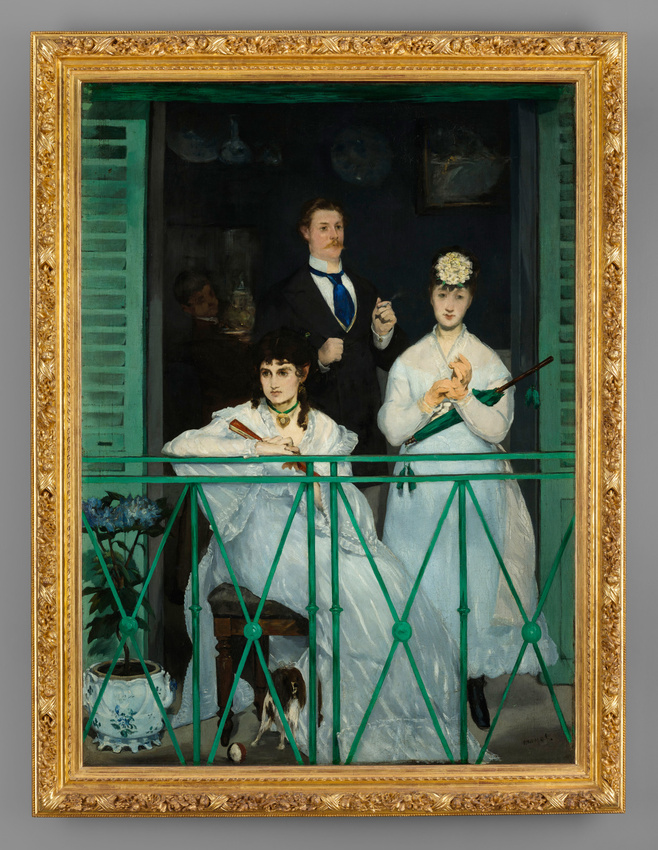
Edouard Manet Le Balcon 1868-1869 Musée d’Orsay
Ahora sí entramos a esta pintura, para empezar quiero enfatizar que este cuadro no es ni el más famoso ni el más estimulante entre las piezas Impresionistas, pero es uno de los más importantes al marcar pautas de esta corriente revolucionaria con efectos sobre artistas como Picasso, Dalí, Diego Rivera, Modigliani hasta Magritte que pintó una alegoría de esta misma obra.
Manet no se sentía un revolucionario en su tiempo, una prueba es que seguía inspirándose en los grandes maestros, como en este caso de Goya con su obra que se llama Majas en el balcón del año 1808.
Lo describiré de una forma breve: se ve un hombre de pie ligeramente retirado, mira hacia el horizonte, las manos un poco en alto, parece indicar que se prepara a dar la vuelta para salir. A su izquierda se ve una señora, la cual tiene una sombrilla en sus manos indicando que va a salir y se está arreglando sus guantes, está vestida de blanco con un sobrerito hecho de flores blancas, nos está mirando. A la derecha del señor está una señorita sentada también vestida de blanco, sus grandes ojos miran al horizonte en la dirección opuesta al señor, tiene un brazo sobre el barandal, un abanico en sus manos y un perrito con una pelota a sus pies.Hay un cuarto personaje apenas visible dentro de la casa.
Para apreciar y entender este cuadro quiero pedirles que se fijen en tres elementos: los colores, la luz, el ambiente.
Los colores de los cuales hay muy pocos; hay blanco, blanco sobre blanco con los encajes de los vestidos y la camisa del señor, con la luz natural vemos que no es el blanco alba de los retratos del Renacimiento o de Vermeer ya que hay tonos amarillos, verdes y grises, tenemos también notas de azul con la corbata del señor y la planta. Y por supuesto verde, en varios tonos, el barandal del balcón, las persianas, la sombrilla, la planta y hasta el perro.
Los colores de los cuales hay muy pocos; hay blanco, blanco sobre blanco con los encajes de los vestidos y la camisa del señor, con la luz natural vemos que no es el blanco alba de los retratos del Renacimiento o de Vermeer ya que hay tonos amarillos, verdes y grises, tenemos también notas de azul con la corbata del señor y la planta. Y por supuesto verde, en varios tonos, el barandal del balcón, las persianas, la sombrilla, la planta y hasta el perro.
Este uso del verde fue severamente criticado en su momento, tildando al artista de excéntrico, que es una dura crítica dado los humores de la época y de tener muy mal gusto.
La luz, es luz natural. Para entender lo excepcional del cuadro hay que entender que la luz como tal jamás se ve en un cuadro o en la realidad, lo que vemos es el efecto de la luz sobre lo que nos rodea y eso es justamente lo que Manet logró representar. Entre sus personajes se ha hablado mucho de nariz de la señora con la sobrilla, se ve casi plana muy lejos de los retratos de las señoras de Botticelli. De hecho así vemos una nariz de frente, percibimos su volumen por la sombra que crea al menos obviamente que la persona esté de perfil.
El ambiente, a primera vista el cuadro parece una naturaleza muerta, personas fijas, una planta, cada cosa en su lugar casi como un escenario de teatro previo a la función. Lo que capta la atención es lo que se ha llamado el efecto de profundidad. No se ha usado técnicas de perspectivas con puntos y líneas como en un cuadro de DaVinci por ejemplo, no se ha usado efectos de chiaroscuro (luz y sombra) o colores para representar el espacio. Manet usó los efectos naturalez de la luz para dar profundidad, la luz se desvanece en oscuridad en la medida en que nuestras miradas van del exterior al interior de la casa, tal y como es en la realidad.
Para concluir esta primera entrada espero que no se hayan aburrido con los términos un tanto técnicos pero para mí el Impresionismo se trató justamente de un experimento mezclado con el afán de representar emociones, que nos permite entender la evolución del arte moderno y apreciar a Matisse, a Picasso o Dalí por ejemplo. Hay que conocer de donde vienen sus técnicas y su manera de plasmar su entorno.
El Impresionismo abrió la puerta a la imaginación en el mundo occidental y a que el artista hiciera uso de su libertad.
Gracias por leerme.
Hello, I'm happy to be writing here for the first time. Today in this post we'll dedicate some time to the Impressionist movement through a brief overview of its origins and with one painting in particular, a painting by Edouard Manet called The Balcony.
First, I'll try to explain the context of this art movement, citing three factors. The first is the Industrial Revolution. The Industrial Revolution brought with it profound structural changes in society: movement in cities, work disconnected from family and home, a certain automatism, and what we could call the beginning of a culture of consumption and pleasure, pleasure had to be bought.
The second factor is photography. The first person to take photographs was the frenchman Daguerre in 1838; that's why the first photograph was called the daguerreotype. It's the ability to capture an instantaneous reality. Reality is immediately placed on a surface; there's no need to wait for someone to paint it, and obviously, it's more accessible.
The third factor, one that few discuss but is equally important, is Japanese inspiration; what was called in french the Japonisme movement. When Japanese art arrived in Europe with the opening of the empire after more than four hundred years of isolation from the rest of the world, artists realized that Japanese art was extremely expressive. There was movement and stillness, vibrant landscapes, wind and rain, active humans, even expressions of silence and noise; the paintings were alive.
These three factors I mentioned, the Industrial Revolution, photography, and Japanese inspiration meant that many began to wonder. The idea of breaking free from conventions became a need, as did letting the imagination grow and, above all, letting the light in.
Edouard Manet, a french painter, and his friends began the change. First, it was with colors; we will return to this later in the post. The most important thing, thanks to Japanese inspiration, was the idea of going outside, focusing on objects or people, and taking them out of the studio. This was partly aided by new tools such as lighter canvases, paint already packaged in metal tubes, etc.
Now we ask ourselves, what happened? I suggest a very simple experiment: take any object, first observe it inside a room, then take it out into daylight, and you will see the difference. When we see an object or people outdoors, we see that each thing has its own color, or more precisely, we see a panoply of colors with a multitude of reflections and tones that overlap.
Before discussing the work specifically, I want to place the Impressionists within the art movement of their time. In 1863, at an official Salon in Paris where works of art were presented, the unconventional works of Manet and others were rejected. Upon experiencing such a reception, they decided to move their pieces to what they called the Salon des Refusés, or Salon of the Rejected. Contrary to expectations, the public that attended did not come to admire the paintings but to be entertained, but as we know, history was kinder to them.
I want to emphasize that the name Impressionist comes from another painting from 1872 called Impression, Sunrise by Claude Monet, which depicts a port in the morning mist. At the time, art critics believed that these so called artists were simply splashing colors along with their signatures.
Edouard Manet Le Balcon 1868-1869 Musée d’Orsay
Now let's delve into this painting. To begin, I want to emphasize that this painting is neither the most famous nor the most stimulating among Impressionist works, but it is one of the most important, setting the standard for this revolutionary movement and influencing artists such as Picasso, Dalí, Diego Rivera, Modigliani, and even Magritte, who painted an allegory of this very work.
Manet didn't consider himself a revolutionary in his time, proof of this is that he continued to draw inspiration from the great masters, as in this case from Goya and his work, Majas on a Balcony, from 1808.
I will describe it briefly: a man stands slightly withdrawn, gazing towards the horizon, his hands slightly raised, seemingly preparing to turn and leave. To his left is a woman holding a parasol, indicating she is about to go out, and adjusting her gloves. She is dressed in white with a small hat made of white flowers and is looking at us. To the gentleman's right sits a young lady, also dressed in white. Her large eyes gaze at the horizon in the opposite direction from the gentleman. She has one arm resting on the balcony railing, a fan in her hands, and a dog with a ball at its feet.There is a fourth figure, barely visible inside the house.
To appreciate and understand this painting, I would like to ask you to focus on three elements: the colors, the light, and the atmosphere.
The colors are few; there is white, white on white with the lace of the dresses and the gentleman's shirt. In the natural light, we see that it is not the pure white of Renaissance portraits or artworks from Vermeer, as there are yellow, green, and gray tones. We also see touches of blue in the gentleman's tie and the plant. And of course, green, in various shades: the balcony railing, the blinds, the parasol, the plant, and even the dog.
This use of green was severely criticized at the time, labeling the artist eccentric, a harsh criticism given the prevailing moods of the era and the perception of poor taste.
The light is natural light. To understand the exceptional nature of the painting, one must understand that light as such is never seen in a painting or in reality; what we see is the effect of light on our surroundings, and that is precisely what Manet managed to represent. Among these figures much has been said about the nose of the lady with the parasol, it appears almost flat, unlike Botticelli's portraits. In fact, we only perceive a nose from the front; we perceive its volume through the shadow it casts unless, of course, the person is in profile.
At first glance, the painting resembles a still life: static figures, a plant, everything in its place, almost like a theater set before a performance. What captures the attention is what has been called the effect of depth. Manet didn't use perspective techniques like Da Vinci, nor did he use chiaroscuro effects (light and shadow) or colors to represent space. He used the natural effects of light to create depth, the light fades into darkness as our gaze moves from the exterior to the interior of the house, just as it is in reality.
To conclude this first post, I hope you weren't bored by the somewhat technical terms, but for me, Impressionism was precisely about an experiment mixed with the desire to represent emotions, which allows us to understand the evolution of modern art and appreciate Matisse, Picasso, or Dalí, for example. It's important to know where their techniques and their way of seeing their surroundings came from.
Impressionism opened the door to imagination in the Western world and allowed artists to exercise their freedom.
Thank you for reading.


No hay comentarios:
Publicar un comentario